Treatment Options
The main aim of a cause-related osteoarthritis therapy is always to reduce inflammation, relieve pain, restore mobility and slow down the progression of the disease.
Treatment Options

Symptoms
When the joints wear out, the first symptom is discomfort on exertion. As the disease progresses these symptoms become more frequent, even during everyday activities. Morning stiffness and so-called start-up pain are typical of arthritis. These pains occur with the first movements after rest. After taking a few steps the pain subsides.
Night-time pain and related sleep disturbances occur as the disease progresses, with painful and painless phases alternating over a long period of time. Gradually, an excruciating continuous pain develops. The symptoms often worsen in cold and damp weather conditions and during physical exertion.
Causes
Severe stress due to hard work, excessive sport, high body weight, environmental factors, heredity, but also metabolic disorders such as gout or diabetes: all these factors may contribute to the development of arthritis and play a role in its development or its severity. Joint injuries can be a cause too, because even the smallest injuries can damage the cartilage and lead to the disease, which is common in about one third of all cases. Above all, however, the development of arthritis is triggered by acute or chronic inflammations of the joint. Depending on the cause, a distinction is made between two forms: primary arthritis and secondary arthritis.

Lorem ipsum dolor sit amet, consectetur adipiscing elit. Ut elit tellus, luctus nec ullamcorper mattis, pulvinar dapibus leo.
Our Therapies

Conservative Treatment
Surgical Intervention

Alternative Approaches

New Insights
The 7 Pillars of Osteoarthritis Care
Intake of the most important
vital substances
Watch your weight
Balanced diet and sport activities
Luxury foods form acids
Fight depression
What you can do
Conventional drugs – only when absolutely necessary
Eat responsibly
Antioxidants against free radicals
Fatty acids against inflammation
Exercise
Recommended sports for osteoarthritis
Improve your biomechanics
Our Prevention

Be Active

Eat Healthy

Avoid Injuries
Ut Wisi Enim Ad Minim Veniam, Quis Nostrud Exerse
Lorem ipsum dolor sit amet, consectetur adipiscing elit. Sed molestie tristique facilisis. Integer pretium nec diam a faucibus. Vivamus lacinia et nulla vestibulum pellentesque. Vivamus nec augue id sapien pharetra sagittis varius non sapien. Integer mattis est arcu, in viverra lectus bibendum at. Sed semper, ex vitae elementum pulvinar, diam diam sodales justo, a lacinia augue augue vel…

In semper metus orci
In semper metus orci, quis elementum felis accumsan sit amet. Nulla vel commodo massa. Lorem…

Lorem Ipsum Dolor Sit Amet
Lorem ipsum dolor sit amet, consectetur adipiscing elit. In vel tincidunt dolor, a malesuada diam….
Treatment Options
The main aim of a cause-related osteoarthritis therapy is always to reduce inflammation, relieve pain, restore mobility and slow down the progression of the disease.
Treatment Options
The main aim of a cause-related osteoarthritis therapy is always to reduce inflammation, relieve pain, restore mobility and slow down the progression of the disease.
There is a wide range of treatment options, from conservative to surgical procedures, as well as alternative treatments. Not all of them have proven successful, and some also cause side effects. What the latest findings show: certain substances can make an important contribution to cartilage health and have a very positive effect on many arthritis complaints, without undesirable side effects.

Conservative
Treatment
The aim of any treatment is to alleviate the discomfort associated with the disease and to relieve strain on the affected joints. There are two classes of medication available for osteoarthritis pain relief. On the other hand, orthopaedic aids such as heel cushion pads, forearm crutches, walking canes and shoe insoles help to reduce the strain on the joints.

Analgesics
Analgesics can temporarily ease the symptoms of arthritis. On the long term, however, they are unsuitable because they usually have numerous side effects when taken over a long period of time. In addition, they do not combat the deeper causes of arthritis, namely the undersupply of the organism with all the building blocks needed for cartilage formation.
Simple “home remedies” such as paracetamol have a painkilling and fever-reducing effect. Furthermore, there are also so-called nonsteroidal anti-inflammatory drugs, or NSAIDs, which are very effective but can also trigger several side effects. The aim of these drugs is to reduce the inflammation in the joint and thus counteract the progression of the disease. However, when taken over a long period of time and in high doses, they can cause a variety of side effects, such as nausea, vomiting, nervousness, headaches, cramps, high blood pressure, confusion and, in the worst cases, even ulcers and bleeding. To make matters worse, NSAIDs can even accelerate the progression of arthritis, as recent studies have shown.
A tip: talk to your doctor in detail about the advantages and disadvantages of pain relievers and clarify whether a therapy with other, possibly natural inflammation blockers and special cartilage-protecting substances may be an option for you.

Physical therapy
In the non-acute arthritis stage, heat treatments have so far proven to be suitable, especially during the inflammation-free phases. The application of heat stimulates the circulation, relaxes the muscles and thus relieves the pain, ideally combined with cartilage-supporting substances. Heat treatments include warm compresses, hot mud and hay flower packs or warm water treatments. The therapy in the acute stage is completely different and foresees cold treatments in the form of ice packs and cold air, which primarily reduce the inflammatory processes.
Surgical Treatment
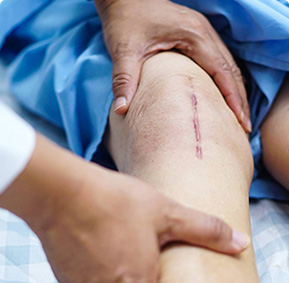
Surgical treatments are usually only the last step after a long conservative treatment and are particularly useful if the goal is to stabilise the joints, correct bad posture or replace the damaged cartilage. Factors such as age, stage of the disease, constitution of the patient and treatment goal play an essential role in determining which surgical measure is the most suitable. Get an overview of available options for surgical treatment.

Analgesics can temporarily ease the symptoms of arthritis. On the long term, however, they are unsuitable because they usually have numerous side effects when taken over a long period of time. In addition, they do not combat the deeper causes of arthritis, namely the undersupply of the organism with all the building blocks needed for cartilage formation.
Simple “home remedies” such as paracetamol have a painkilling and fever-reducing effect. Furthermore, there are also so-called nonsteroidal anti-inflammatory drugs, or NSAIDs, which are very effective but can also trigger several side effects. The aim of these drugs is to reduce the inflammation in the joint and thus counteract the progression of the disease. However, when taken over a long period of time and in high doses, they can cause a variety of side effects, such as nausea, vomiting, nervousness, headaches, cramps, high blood pressure, confusion and, in the worst cases, even ulcers and bleeding. To make matters worse, NSAIDs can even accelerate the progression of arthritis, as recent studies have shown.
A tip: talk to your doctor in detail about the advantages and disadvantages of pain relievers and clarify whether a therapy with other, possibly natural inflammation blockers and special cartilage-protecting substances may be an option for you.

This measure is not only used for arthritis, but in general for bad posture as arthritis prevention. Especially in the case of incipient arthritis, this correction slows down wear of the joint and prevents premature prosthesis. Specifically, corrective osteotomy restores the normal alignment of the joint-forming bones to redistribute the load on the joint surfaces. Usually, the surgery involves ligaments and the joint capsule to make the joint more mobile and/or stable.

The best known is the endoprosthetic replacement of the hip and knee joints. This procedure is mainly considered when all previous treatments have failed and the joint cartilage is almost completely destroyed. The worn body of the affected joint surfaces is removed and replaced with a prosthesis made of plastic, metal or ceramic. Bad posture of the joint can also be corrected during this operation. Unfortunately, prostheses can become loose over time and therefore need to be replaced or reattached regularly. Knee joint prostheses last about 10 years, hip prostheses in the best case a lifetime.

In simple terms, arthrodesis is a joint fusion that restores stiffness. This procedure can stabilize an unstable joint and correct a deformed one. After surgery, the joint is more stable but less mobile because the bones that form the joint are firmly linked together. Arthrodesis is mostly used for arthroses in the area of the finger end joints, other finger joints and the wrist joint as well as the metatarsophalangeal joint of the big toe.
Alternative Treatments
Although not all alternative healing methods have yet been scientifically proven, many patients expect success from non-academic measures to alleviate their pain and minimize discomfort. We have compiled an overview of the most common methods.
Acupuncture
In this traditional Chinese technique, fine needles are inserted into the skin in specific body regions in order to support the flow of energy in the body, release blockages and ultimately relieve chronic pain. This treatment method has already proven successful, especially for patients with knee arthritis. However, the treatment, which often involves several sessions, must be repeated regularly.
Magnetic therapy
In magnetic therapy, electromagnetic energy fields are supposed to stimulate the self-healing powers of the human body, support the build-up of cartilage, reduce the swelling of the joints and relieve pain. Some patients experience a feeling of warmth or a slight tingling sensation during the treatment. Incidentally, this form of therapy has no side effects.
Medical plants and homeopathy
Medicinal plants can support the therapy in a natural way. Dandelion, cayenne pepper, stinging nettle, rosehip and African devil’s claw are particularly suitable for this purpose. All these plants are supposed to reduce inflammation, strengthen the connective tissue and stimulate and promote blood circulation.
Homeopathic remedies can have a stimulating effect on the self-healing and regenerative forces, too. Rhus toxicodendron, for example, can relieve pain in the cervical vertebrae, as well as joint stiffness. Other effective remedies are Arnica montana C5, e.g. for sore muscles and stabbing pains, or Angustura vera C5 for muscle cramps and spasms.

The exact mechanisms that lead to arthritis have not yet been clarified. However, scientists assume that in the course of ageing, the human body produces and/or ingests too few of the nutrients needed to keep the cartilage mass healthy and maintain the quality of the joints. Glucosamine, chondroitin and hyaluronic acid have proven to be important joint protectors in the treatment of arthritis.
The endogenous substance glucosamine, a so-called amino sugar that is very similar to D-glucose, plays a very important role in maintaining cartilage tissue healthy and is therefore an important building block of cartilage substance. Among other things, it keeps the cartilage mass soft and flexible, supports cartilage regeneration by promoting the formation of new cartilage cells and stimulates the production of synovial fluid. As already proven in many studies, on the one hand glucosamine reduces inflammation and relieves pain, and on the other hand it protects from age-related wear and tear. What studies have also shown is that glucosamine is often reduced in affected joints. Unfortunately, it may be difficult to take the substance in sufficient quantities through diet alone, as it is hardly found except in shellfish and certain mushrooms. Incidentally, it is almost exclusively absorbed as glucosamine sulphate.
Chondroitin, or chondroitin sulphate, is another important cartilage component. This is a branched-chain sugar in which two different sugar molecules – D-glucuronic acid and N-acetyl-galactosamine – alternate. Chondroitin improves joint mobility and slows down the cartilage loss, as is the case with arthritis. Chondroitin also plays a role in bone fracture healing. Furthermore, it protects cartilage from premature, age-related wear and tear by preventing the activity of certain cartilage-degrading enzymes and fighting other enzymes that starve cartilage tissue. It reduces inflammation in the joint and therefore joint pain, further preventing age-related deterioration. Like glucosamine, chondroitin must be added to the body, as it is hardly present in the diet.
Hyaluron or hyaluronic acid is polysaccharide, too, but with a linear structure, consisting of D-glucuronic acid and A-acetyl-glucosamine. Hyaluronic acid is the main component of synovial fluid and is also found in large quantities in the joint cartilage itself. Its function is to make the water stored in the tissue viscous and to ensure the sliding of the joint surfaces, which in turn is important for the stability and flexibility of the joint cartilage. Until now, patients with arthritis have usually been treated with hyaluronic acid injections, which are expensive and often require a long-term treatment. In addition, the use of injections carries a high risk of infection. In the meantime, however, researchers have succeeded in converting this important cartilage component into a special dosage form, making it possible to deliver it in pills or capsules.
Methyl sulfonyl methane, or MSM, is another substance that plays an important role in cartilage health: MSM has an anti-inflammatory and pain-relieving effect and is involved in the regeneration of cartilage and connective tissue. It supports the body in restoring destroyed cells and tissue structures and thus makes an important contribution to the functioning of the entire musculoskeletal system. Methyl sulfonyl methane is found in almost all foods, such as milk, fruit, vegetables, cereals, meat or fish, but unfortunately it is mostly destroyed by heating the food.
The two important trace elements zinc and manganese are also essential for the effectiveness of those enzymes that play a significant role in building cartilage mass and synovial fluid. Important antioxidants that protect the organism from the damaging effects of free radicals, which in turn destroy cells and tissue structures, are vitamin C, contained in many fruits and vegetables, as well as resveratrol and OPC, oligomeric proanthocyanides, obtained from grapes.
Chrono-biological optimization of joint protection substances
When taking these joint protection substances, it is important to pay attention to the findings of chronobiology. It is known that many substances often have an optimal action window depending on the time of day, when they are either better absorbed and/or their effectiveness is highest. This is the only way to ensure the optimal supply and to achieve rapid pain relief.
Vitamin C, for example, is best absorbed in the morning, possibly with small amounts of resveratrol, which increase this absorption. On the contrary, the intake of zinc, manganese and oligomeric proanthocyanides should preferably take place in the evening. Higher amounts of resveratol have proven more effective in the evening, too, as this is when your antioxidant potential is at its highest. Glucosamine, chondroitin, MSM and hyaluronic acid can be taken both in the morning and in the evening.
The seven pillars of arthritis treatment
This innovative method for the prevention and treatment of arthritis is based on seven pillars which are complementary to one another and have a clear goal: minimize the risks and the causes of arthritis, alleviate your discomfort, reduce your pain, support your mobility and thus improve your quality of life again.